 Back in December, Varda from my favorite bread website The Fresh Loaf posted a request for an authentic Portuguese bread recipe for Broa. I did a quick search on the internet myself and came up with a couple of interesting options. The one I baked the other day was very interesting in regards to how the dough is actually shaped which is what convinced me to give it a try. After the dough bulk rises you divide and roll the dough around a bowl that has been filled with water and then lightly floured. It was very simple and fun to try and came out pretty good. The original recipe was posted here.
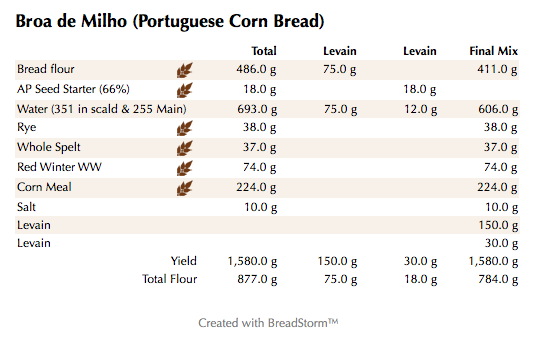
The recipe is not very specific in regards to all of the ingredients so I converted everything to grams and converted my starter to an almost 100% hydration one. I usually like to bulk ferment the dough in the refrigerator but I decided to follow the recipe and let it sit overnight at room temperature which was around 68 degrees. I think next time I would bulk retard the dough in the refrigerator to get some additional flavor.
This recipe also calls for a corn meal “scald and a multi-grain flour mix. The original recipe used rye, wheat and barley but I changed it up a bit and used rye, spelt and red winter wheat.
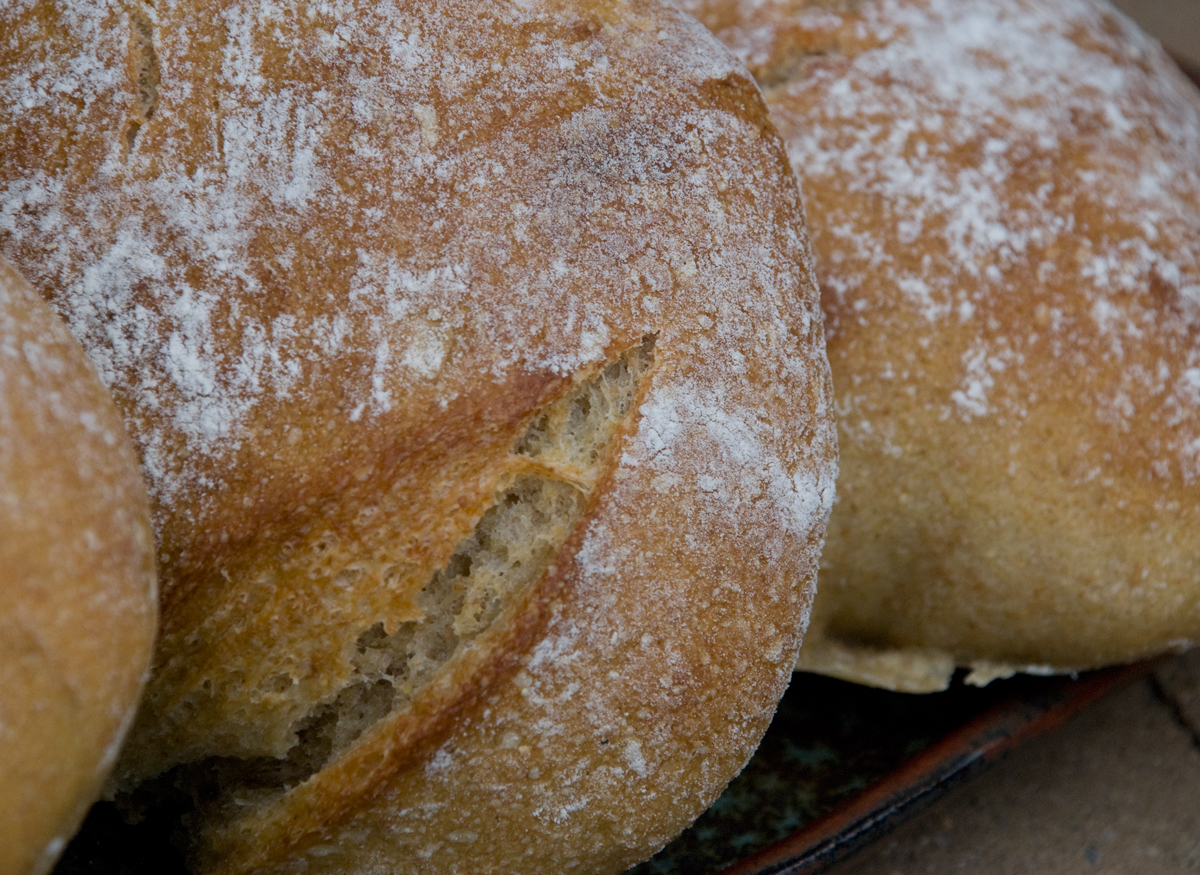
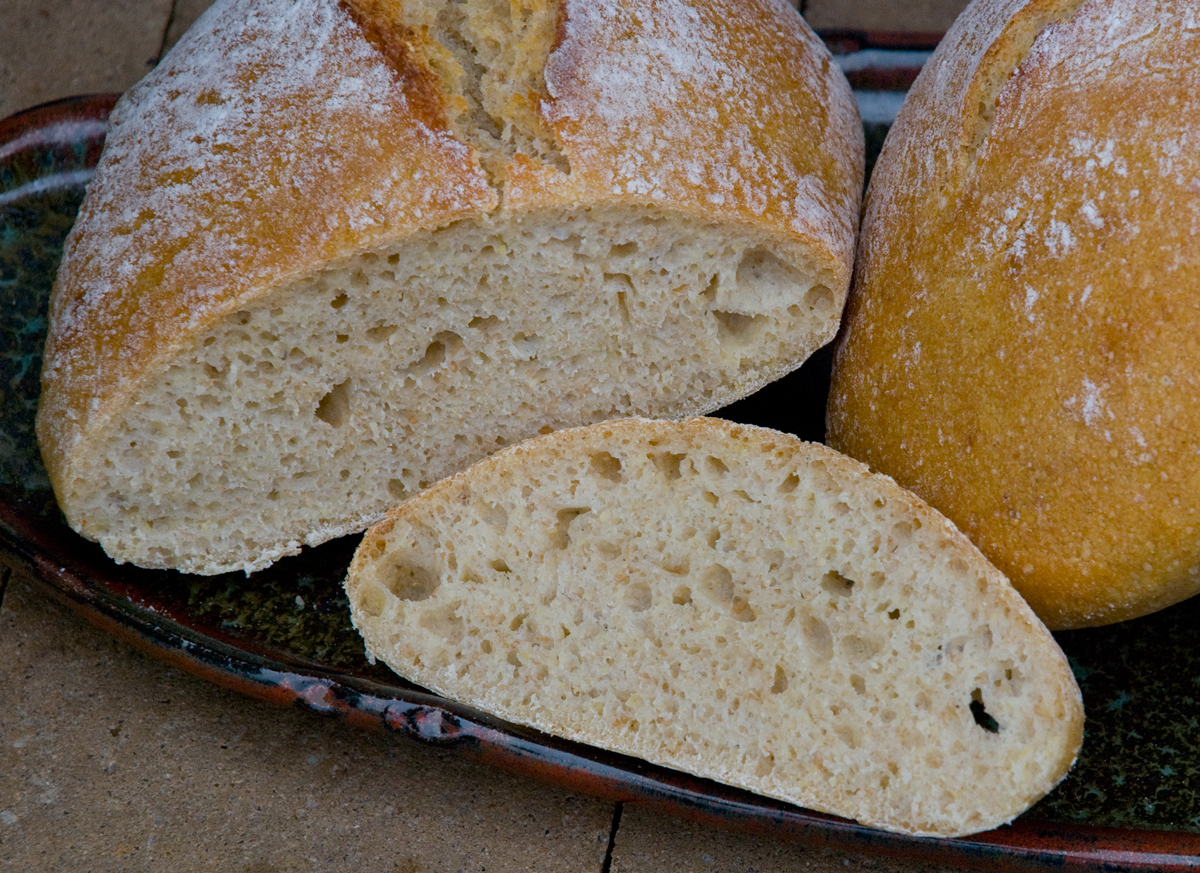
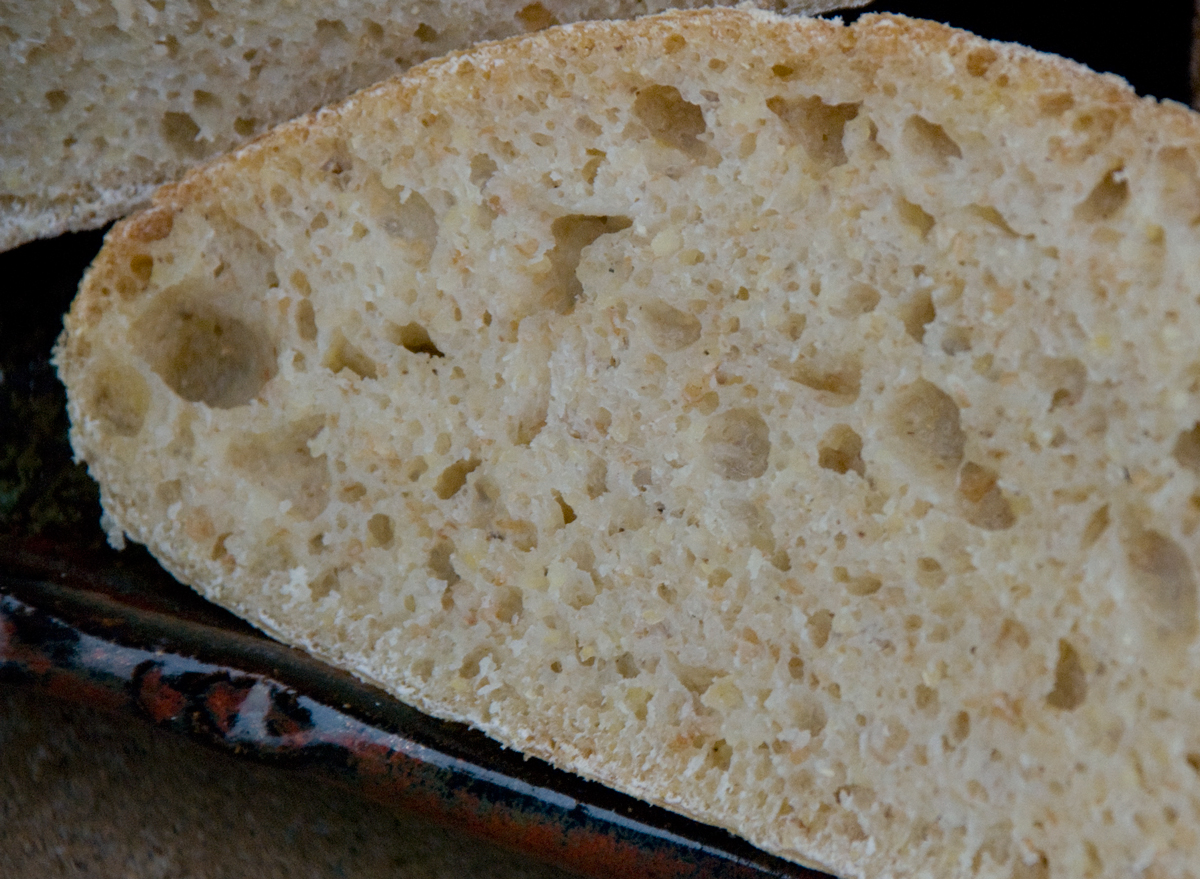
I think the final baked dough came out pretty good with a nice sour tang and you can definitely taste the corn meal influence. Give this one a try if for nothing more than to try the unique shaping technique.


Levain Directions
Mix all the levain ingredients together for about 1 minute and cover with plastic wrap. Let it sit at room temperature for around 7-8 hours or until the starter has doubled. I used my proofer set at 83 degrees and it took about 4 hours.
Corn Scald
Pour 351 grams of boiling water over the 224 grams of fine corn meal and mix to form a mush. Let it sit and cool for around 20 minutes.
Main Dough Procedure
Mix the flours and levain with the cooled corn scald for a minute. Next add the salt and the remainder of the water and mix for around 5-6 minutes until a soft dough has been achieved. Remove the dough from your bowl and place it in a lightly oiled bowl or work surface and do several stretch and folds. Let it rest covered for 10-15 minutes and then do another stretch and fold. Let it rest another 10-15 minutes and do one additional stretch and fold. Let the dough sit out in your covered bowl overnight for around 10-12 hours.
The next morning you should have a nice puffy dough that has doubled in size. Carefully transfer the dough to your work surface and divide into 4 equal parts but be careful not to deflate the dough.
Prepare a large mixing bowl by filling it with cold water and pouring it out. Next dust the inside of the bowl with flour so it is completely covered.
Now for the fun part! Take the first piece of dough and carefully place it in the floured bowl and swirl it around for around 15 – 20 seconds until it starts to get roundish. Place it on a parchment covered baking sheet and dust with flour. Repeat for the other 3 pieces and cover with either a moist lint free towel or sprayed plastic wrap.Let the dough sit at room temperature for around 2 hours. The dough should puff up and spread out so don’t be alarmed. Do the poke test to make sure you don’t over-proof them.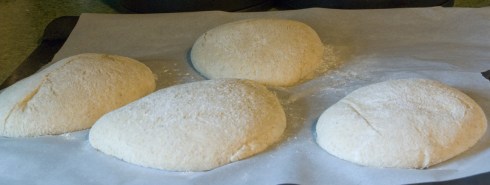

Around 45 minutes before ready to bake, pre-heat your oven to 550 degrees F. and prepare it for steam. I have a heavy-duty baking pan on the bottom rack of my oven with 1 baking stone on above the pan and one on the top shelf. I pour 1 cup of boiling water in the pan right after I place the dough in the oven.
Right before you are ready to put them in the oven, add 1 cup of boiling water to your steam pan or follow your own steam procedure.
Immediately lower the temperature to 450 degrees. Bake for 15-20 minutes and then lower the temperature to 400 degrees until the crust is nice and brown and the internal temperature of the bread is 210 degrees.
Take the bread out of the oven when done and let it cool on a bakers rack before for at least 2 hours before eating.

Lexi trying to score some flour…..
This post has been submitted to the Yeast Spotting Site here: http://www.wildyeastblog.com/category/yeastspotting/.

 mookielovesbread
Nice bread!
Thanks! Glad you like it.
What a funny way of shaping – it’s amazing that there are still ways out there to do this in a different manner – I thought I knew them all. Nice breads!
Thank you Karin.. It is amazing what you can learn just by looking on the web. If it wasn’t for Varda’s question about this type of bread I would never have found it.
that seems to be a nice bread, but it’s not even close to being “broa de milho”. the crust of “broa de milho” is really thick and cracked and the crumb really dense, heavy and a little moist.
see these? http://2.bp.blogspot.com/-8w669ALp_Os/TZ3Hm-u_D4I/AAAAAAAAAPY/KjVOF6NRRKg/s640/Broa_de_Milho.JPG
only use corn flour and a bit of rye in some variations, plus wheat flour. forget about the rest. my weblog is resting at the moment, as I don’t have any time for it right now, but once I post something similar to the real thing, I’ll share with you.
I’m Portuguese, by the way. and I follow your weblog since a long time already and I like it. oh, and my kittens also love my bread.
Hi Dora,
The person who I adapted this recipe from claims to be Portuguese so I assumed his recipe was authentic. Maybe there are different variations?
In any regards, I will check out your suggestions and give those a try when I can.
Thanks for following my blog and I appreciate your feedback.
Regards,
Ian
Hello, Ian
I’m speaking of what I know as typical. Broa is a type of bread typical in the North of Portugal. As wheat didn’t grow there, but only in the South, the peasents used mainly what they could reach, which was mostly rye and corn. “Broa de Milho” or “Pão de Milho” is traditionally made using only those two cereals. Only later arrived versions with wheat, specially coming from central regions of the country. There are also variations in the type of corn used, more white corn in the North, more yellow corn in the center. And in the North you can also find “Broa de Centeio”, another dense bread mainly made of rye. One of the most distinguished types is “Broa de Avintes”.
The spelt that you used is not a thing that you find typically in any kind of Portuguese bread.
Returning to “Broa de Milho”, the dough when raw is quite dense but sticky. To leaven it, you use old dough. I’m sharing here the process in a video I found. Well, a video in five parts. Even not understanding the language, you can see how the dough is worked.
I hope this can help.
Dora