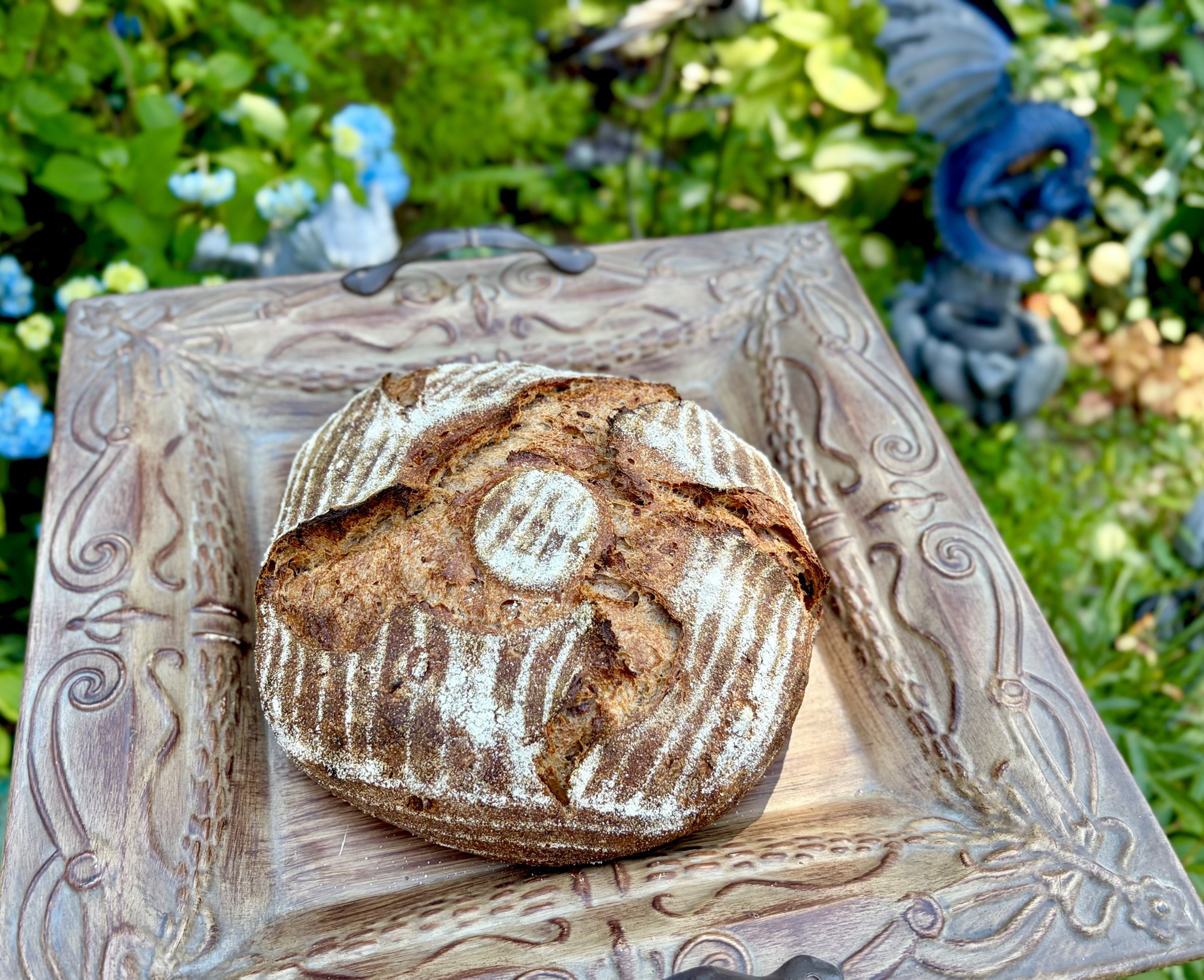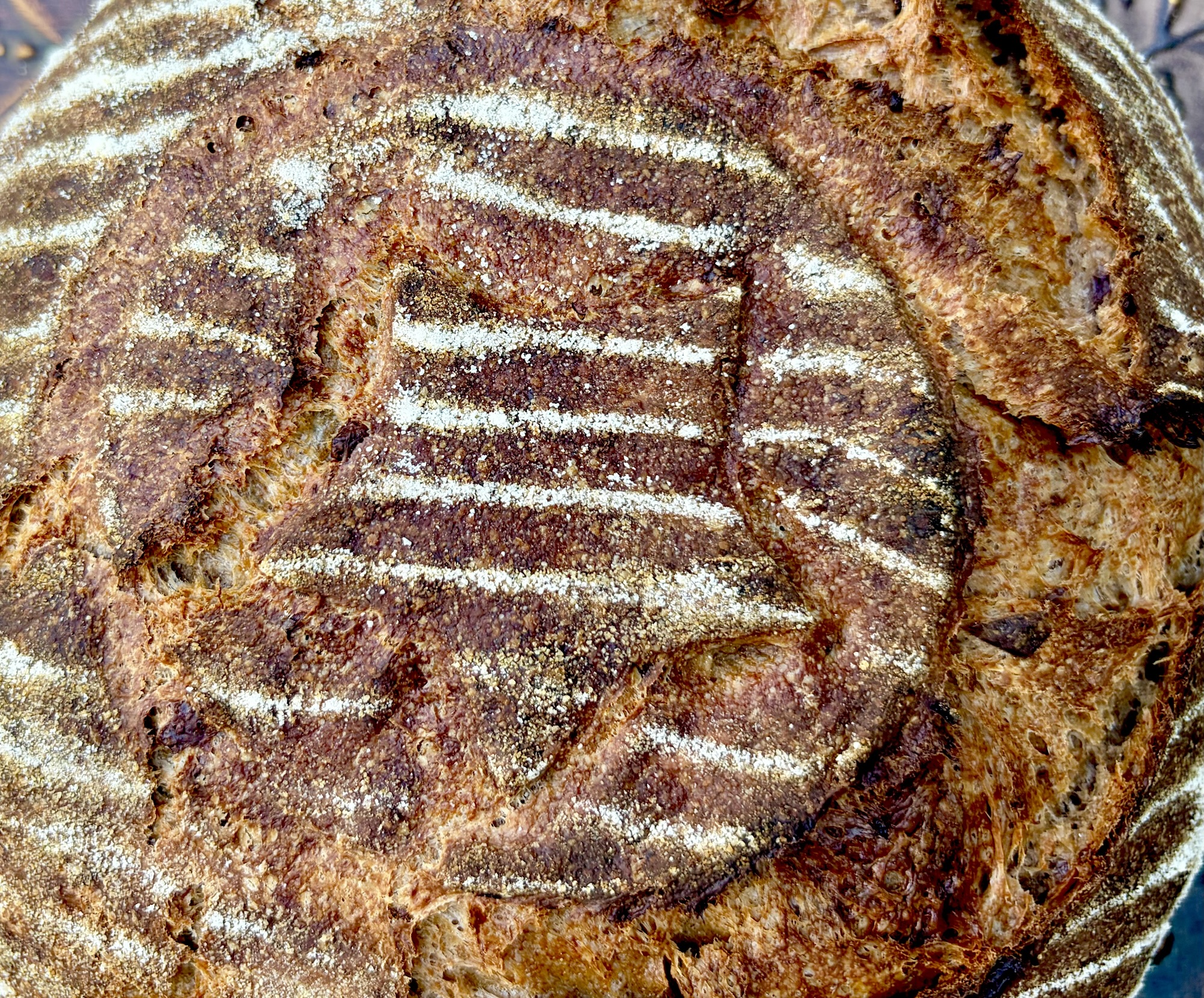
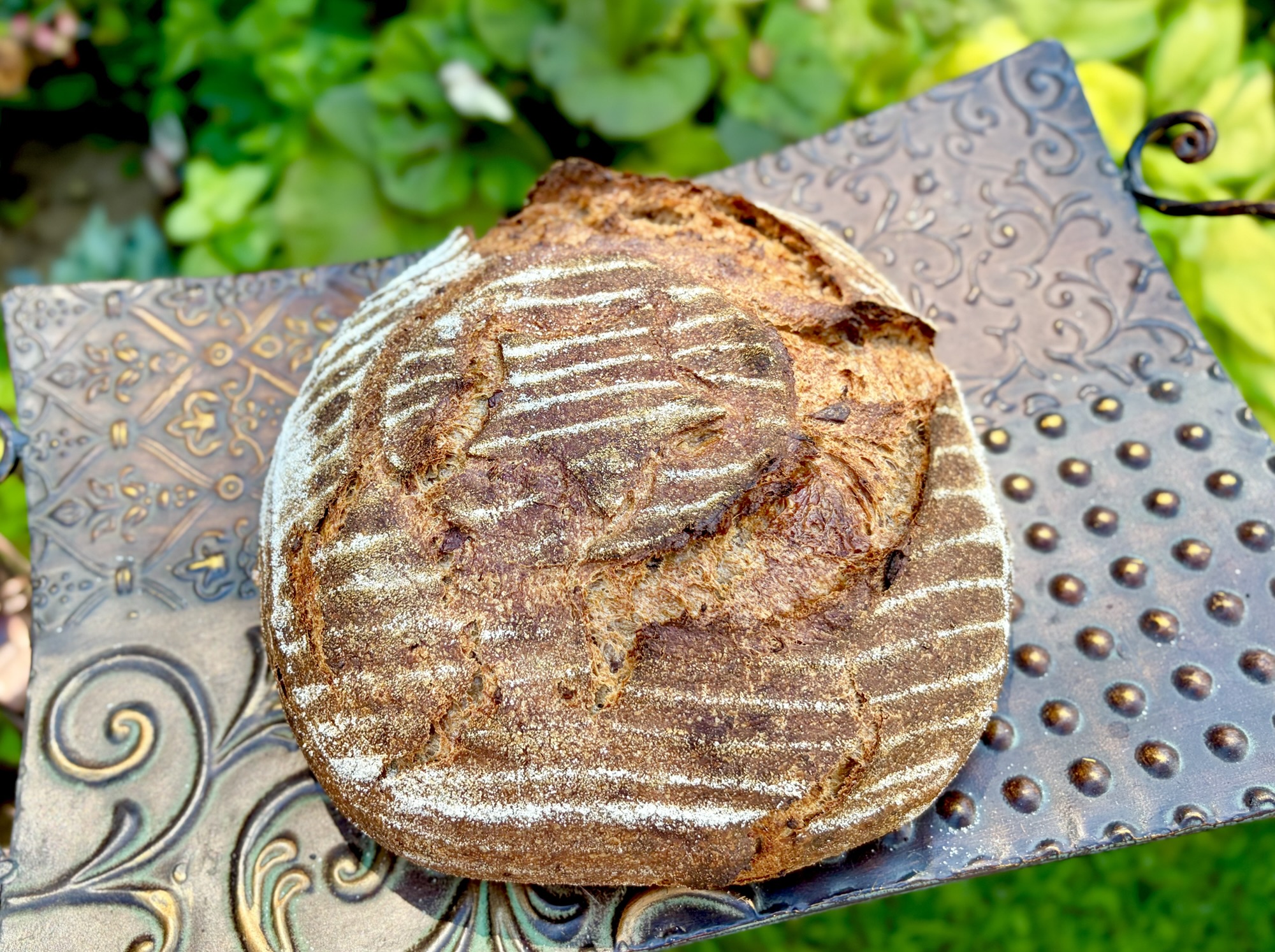
Stardust Wheat with Rye, Einkorn and a Rye Tangzhong

It’s been a while since I used some rye in one of my bakes, so I figured it would go well with some fresh milled Stardust wheat and Einkorn. The crumb was very open for a 76% FMF bake. It was soft and flavorful.

The Ryman Rye and Stardust Wheat for the main dough were both milled with my Mockmill 200 and sifted once with a #30 drum sieve and re-milled at the finest setting. The Einkorn was not sifted, as was the rye for the Tangzhong.

The dough temperature was 76°F, and I let it bulk proof at 76°F until it reached around 50% rise in my proofer. Total time of bulk fermentation from when the starter was added was 6.5 hours.

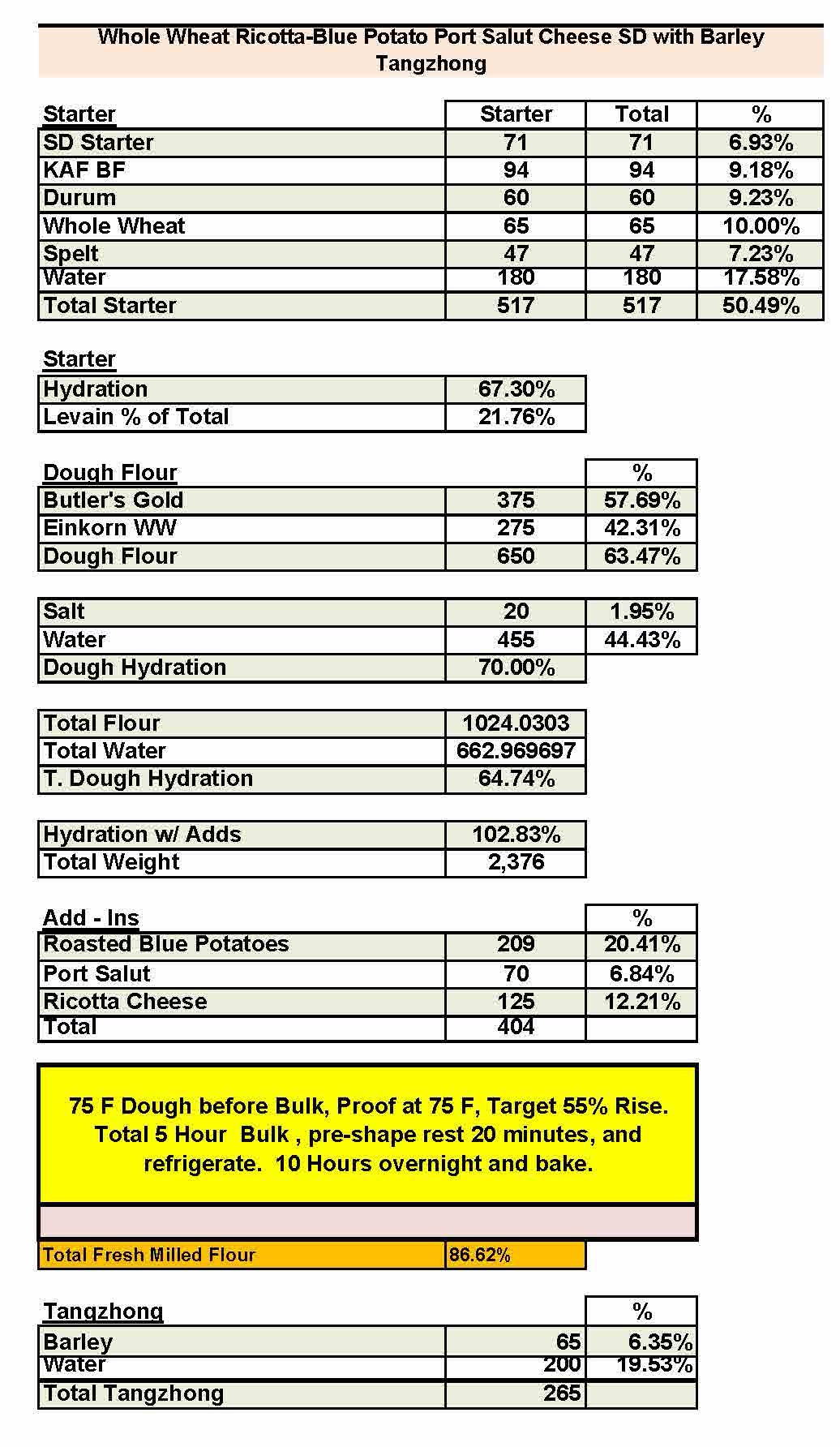
Formula

Levain Directions 

Mix all the levain ingredients together for about 1 minute and cover.

Let it sit at room temperature (I used my proofer set at 75°F) for around 5-7 hours or until the starter has almost doubled. I like to use the starter as soon as it has peaked.

Tangzhong Directions

Add the water to the rye flour in a small saucepan and cook on medium-low until the starches gelatinize and it starts to thicken. It should be like wallpaper paste when done. Remove from the heat and cool until it’s about room temperature. I have started putting it in an ice water bath to cool it quicker, and it’s kept it’s lose consistency this way.

 Main Dough Procedure

Note: I use an Ankarsrum Mixer, so my mixing order is slightly different from that of a KitchenAid or other mixer. Add all the water to your mixing bowl except for about 1/4 of the water. Add all the flour to the bowl and mix on low for 1 minute, until it forms a shaggy mass. Cover the mixing bowl and let it rest for 25 minutes.   Next, add the levain, Tangzhong, sour cream, maple syrup, and most of the remaining water (as needed), and mix on medium-low speed (about speed 4) for around 15 minutes. Let it rest for another 20-25 minutes. Now add the salt and the remaining water if needed, and mix on speed 4-5 until you have a nicely developed, smooth dough. Don’t be afraid to mix longer. I have found that upfront gluten development is key if you want a nice open crumb.

Remove the dough from the bowl and place it in a lightly oiled bowl or proofing container, and do several stretch and folds.  Make sure the dough is as flat as possible in your bowl/container, and measure the dough in millimeters and take the temperature of the dough. Based on the chart from http://www.thesourdoughjourney.com, determine what % rise you need and make a note. If you have a proofer, decide what temperature you want to set it at and what rise you are aiming for.

Do a set of coil folds after 30 minutes, and a second one 30 minutes later, and then one set of stretch and folds 30 minutes later. It’s important to build the layers of gases by doing the coil folds.

Once the dough reaches the desired bulk rise, pre-shape and let rest for 15-20 minutes. Finish shaping and place the dough in your banneton, bowl, or on a sheet pan, then cover it to keep it airtight.

When you are ready to bake, preheat your oven to 500°F an hour beforehand and prepare for steam. When ready to bake, score as desired. Prepare your oven for steam. I have a heavy-duty baking pan on the bottom rack of my oven with 1 baking stone above the pan and one on the top shelf.  I pour 1 cup of boiling water into the pan right after I place the dough in the oven.  I then lower the oven temperature to 450°F and bake until they are nice and brown, and the internal temperature is at least 205 – 210°F.

Take the bread(s) out of the oven when done and let them (it), cool on a baker’s rack for as long as you can resist. 
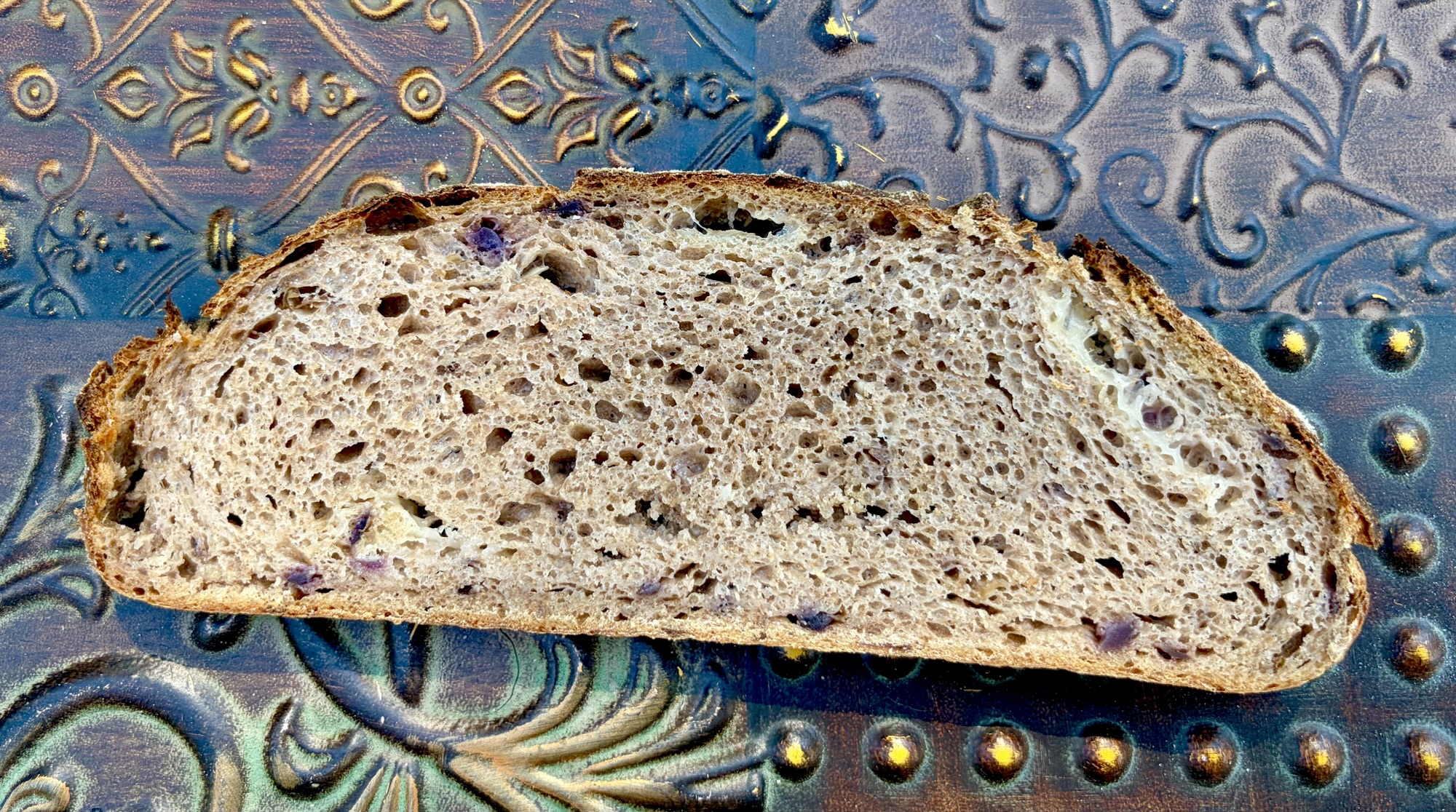
Durum-Whole Wheat Rustic Potatoes with a Durum Tangzhong, Rolls

These are probably the softest rolls I’ve ever baked. Made with fresh-milled durum and Butler’s Gold WW with a little KA bread flour in the levain.

Milled with my Mockmill 200. The durum for the levain and Tangzhong were used whole, and the main dough flour was sifted with my #30 drum sieve and then re-milled at the finest setting.

I used the water from cooking the potatoes for the main dough. The potatoes were a combo of yellow and blue varieties. I mashed them up with some leftover tzatziki sauce and left the skins on.

I mixed these in my Ankarsrum as always. I finished the bulk in the refrigerator and shaped them cold the next morning. I let them rise for about an hour until they were nice and puffy and baked them with steam at 445 F.

These are perfect for burgers and sandwiches and taste 100% better than any store-bought rolls.

Formula

Levain Directions 

Mix all the levain ingredients together for about 1 minute and cover with plastic wrap.

Let it sit at room temperature (I used my proofer set at 75°F) for around 5-7 hours or until the starter has almost doubled. I like to use the starter as soon as it has peaked. You can refrigerate it and use it later or the next day, but it may lose some of its strenght if not used right away.

Tangzhong Directions

Add the water to the durum flour in a small saucepan and cook on medium-low until the starches gelatinize and it starts to thicken. It should be like wallpaper paste when done. Remove from the heat and cool until it’s about room temperature. You can put it in the refrigerator to speed up the process.

Potatoes Directions

Boil the potatoes in salted water and simmer until fork-tender. I left the skins on for more rustic mashed potatoes. Save the potato water and let it cool for use in the main dough. Mash the potatoes, leaving them slightly chunky. I added some leftover Tzatziki sauce to make them creamy. You can add some butter if desired instead, or sour cream or Greek yogurt, or use leftover mashed potatoes. I also used a combination of blue potatoes and golden yellow baby potatoes.

 Main Dough Procedure

Note: I use an Ankarsrum Mixer, so my mixing order is slightly different from that of a KitchenAid or other mixer. Add all the water to your mixing bowl except for about 1/4 of the water. Add all the flour to the bowl and mix on low for 1 minute, until it forms a shaggy mass. Cover the mixing bowl and let it rest for 20 minutes.   Next, add the levain, Tangzhong, sour cream, olive oil, and most of the remaining water (as needed), and mix on medium-low speed (about speed 4) for around 15 minutes. Let it rest for another 20-25 minutes. Now add the salt, potatoes, and the remaining water if needed, and mix on speed 4 until you have a nicely developed, smooth dough. Don’t be afraid to mix longer. I have found that upfront gluten development is key if you want a nice open crumb.

Remove the dough from the bowl and place it in a lightly oiled bowl, and do several stretch and folds.  Make sure the dough is as flat as possible in your bowl/container, and measure the dough in millimeters and take the temperature of the dough. Based on the chart from http://www.thesourdoughjourney.com, determine what % rise you need and make a note. If you have a proofer, decide what temperature you want to set it at and what rise you are aiming for. Since I decided to let the dough finish proofing for bulk in the refrigerator, I let it rise about 10% less. Even if you let it go the full amount, the rolls are forgiving.

Do a set of coil folds after 30 minutes, and a second one 30 minutes later, and then one set of stretch and folds, 30 minutes later. (Note: since this dough was very sticky, I did an extra set of coil folds). It’s important to build the layers of gases by doing the coil folds.

Once the dough reaches the desired bulk rise, refrigerate it overnight.

The next morning, let the dough sit out for an hour or so and then shape into rolls. I made these around 140-150 grams for hamburger bun size. You can go smaller if desired, and you can also shape them into hot dog buns. Brush the rolls with an egg wash. I include a pinch of salt in the egg wash. Sprinkle on your toppings as desired. I used black sesame seeds on some rolls and everything bagel seasoning on the others.

When you are ready to bake, preheat your oven to 475°F an hour beforehand and prepare for steam. Prepare your oven for steam. I have a heavy-duty baking pan on the bottom rack of my oven. I pour 1 cup of boiling water into the pan right after I place the rolls in the oven.  I then lower the oven temperature to 445°F and bake until they are nice and brown, and the internal temperature is at least 205 – 210°F.

Take the rolls out of the oven when done and let them cool on a baker’s rack for as long as you can resist. 

Durum-Spelt Egg SD with a Barley Scald

I was very happy with how this one turned out. This bake was made with 83% fresh milled flour, mixed in my Ankarsrum and open baked with steam.

The FMF was sifted through a #30 drum sieve, and about 3% of the bran was removed. The barley for the scald was not sifted.

The crumb was fairly open. This is a wet dough when you calculate the water content of the eggs and the scald.

This bread tasted like a Challah on steroids. It’s worth trying.

Formula

Levain Directions 

Mix all the levain ingredients together for about 1 minute and cover with plastic wrap.

Let it sit at room temperature for around 6-7 hours or until the starter has almost doubled. Either use in the main dough immediately or refrigerate for a few hours before using.

Scald Directions

Pour boiling water over the ingredients and mix until incorporated. Cover and let cool to room temperature. I put mine in the refrigerator to let it cool quicker.

 Main Dough Procedure

Note: I use an Ankarsrum Mixer, so my order of mixing is slightly different from that of using a KitchenAid or other mixer. Add all the water to your mixing bowl except the 70 grams of water. Add all your flour to the bowl and mix on low for a minute until it forms a shaggy mass. Cover the mixing bowl and let it rest for 20 – 30 minutes.   Next, add about half of the remaining water, honey, eggs, and the scald and mix for a minute. Add the levain next and mix for 10 minutes, increasing the speed to position #4. Let the dough rest for 15-20 minutes and then add the remaining water and salt, and mix on medium (about speed 4) for around 14 minutes until you have a nicely developed, smooth dough. If necessary, mix longer. You want to have good gluten development from mixing the dough.

Remove the dough from your bowl and place it in a lightly oiled bowl, and do several stretch and folds.  Make sure the dough is as flat as possible in your bowl/container, and measure the dough in millimeters and take the temperature of the dough as well. Based on the chart from http://www.thesourdoughjourney.com, determine what % rise you need and make a note. If you have a proofer, decide what temperature you want to set it at and what rise you are aiming for. I had a DT of 75 F and set my proofer to 75 F and aimed for a 50% rise. The more experienced you get, the better you will be at knowing how far you can push your bulk proofing. I pushed this one to around a 55% rise. Do 2 sets of coil folds, 30 minutes apart. After another 30 minutes, do a set of stretches and folds. 

Once the dough reaches the desired bulk rise, place it on your work surface after spraying some cooking spray. I never use extra flour unless I’m making a ciabatta. Pre-shape and let it rest for 15-20 minutes. Do you final shaping and place it in your basket, and cover it if desired with a moist kitchen towel. Place it in the refrigerator overnight for 10-14 hours. I find if I go much longer with so much FMF, it tends to over-proof.

Once the dough reaches the desired bulk rise, pre-shape and let rest for 15-20 minutes. Finish shaping and place the dough in your banneton, bowl, or on a sheet pan, then cover it to keep it airtight. Some people prefer to do the overnight proof without covering the dough. Place it in the refrigerator overnight for 10-14 hours. I find that if I go much longer with so much FMF, it tends to over-proof.

When you are ready to bake, preheat your oven to 500°F an hour beforehand and prepare for steam. When ready to bake, score as desired. Prepare your oven for steam. I have a heavy-duty baking pan on the bottom rack of my oven with 1 baking stone above the pan and one on the top shelf.  I pour 1 cup of boiling water into the pan right after I place the dough in the oven.  I then lower the oven temperature to 450°F and bake until the loaf is nice and brown, and the internal temperature is at least 205 – 210°F.

Take the bread(s) out of the oven when done and let them (it), cool on a baker’s rack for as long as you can resist.  

Cream Cheese Onion Rye Whole Einkorn-Stardust w/ Rye Tangzhong

Made with fresh milled Einkorn with no bran sifted out. The Danko Rye for the Tangzhong was also unsifted FMF. The Stardust WW and Danko rye for the main dough were sifted with a #30 drum sieve and then re-milled at the finest setting in my trusty Mockmill 200.

I hadn’t used Einkorn in a long time and forgot how flavorful it was. It mills into a very soft and powdery flour, so I didn’t feel the need to sift any bran and re-mill.

I used dehydrated onions which were rehydrated with water and added during the final mix.

This has a nice amount of rye and really made for a sticky dough.

It may have been a touch over-fermented, but overall it came out very well. You can taste the rye and the onions. The cream cheese added a little extra creaminess to the fairly open crumb.

The fresh milled flour came out to 75.61% of the total flour used in this bake.

Formula

Levain Directions 

Mix all the levain ingredients together for about 1 minute and cover with plastic wrap.

Let it sit at room temperature (I used my proofer set at 75°F) for around 5-7 hours or until the starter has almost doubled. I like to use the starter as soon as it has peaked. You can refrigerate it and use it later or the next day, but it may lose some of its strenght if not used right away.

Tangzhong Directions

Add the water to the whole rye flour in a small saucepan and cook on medium-low until the starches gelatinize and it starts to thicken. It should be like wall paste when done. Remove from the heat and cool until it’s about room temperature. You can put it in the refrigerator to speed up the process.

 Main Dough Procedure

Soak the dehydrated onions in water for about 30 minutes to an hour. Drain the onions well and reserve the water to use as part of the water for the main dough. Make sure you take the temperature of your flour after milling if using FMF and adjust your water temperature used in the final dough accordingly. Depending on how much friction and heat your mixer imparts, you want to adjust your water temperature so that after mixing, your dough temperature is ideally 75° F or no more than 80° F. I prefer to aim for a target DT of 75° F and a bulk rise around 50%-55%. If I go to 80° F, I shoot for a 30%-35% rise.

Once you learn how to read your dough and look for the signs that it is properly fermented, you don’t need to be as concerned about the % rise during bulk.

Note: I use an Ankarsrum Mixer, so my mixing order is slightly different from that of a KitchenAid or other mixer. Add all the water to your mixing bowl except about 1/4. Add all the flour to the bowl and mix on low for 1 minute, until it forms a shaggy mass. Cover the mixing bowl and let it rest for 20 minutes.   Next, add the levain, Tangzhong, cream cheese, and most of the remaining water (as needed), and mix on medium-low speed (about speed 4) for around 15 minutes. Let it rest for another 20-25 minutes. Now add the salt, softened dehydrated onion, and the remaining water if needed, and mix on speed 4 until you have a nicely developed, smooth dough. Don’t be afraid to mix longer if your dough feels like it needs it. I have found that upfront gluten development is key if you want a nice open crumb.

Remove the dough from the bowl and place it in a lightly oiled bowl or proofing container, and do several stretch and folds.  Make sure the dough is as flat as possible in your bowl/container, and measure the dough in millimeters and take the temperature of the dough. Based on the chart from http://www.thesourdoughjourney.com, determine what % rise you need and make a note. If you have a proofer, decide what temperature you want to set it at and what rise you are aiming for.

Do a set of coil folds after 30 minutes, and a second one 30 minutes later, and then one set of stretch and folds, 30 minutes later. It’s important to build the layers of gases by doing the coil folds.

Once the dough reaches the desired bulk rise, pre-shape and let rest for 15-20 minutes. Finish shaping and place the dough in your banneton, bowl, or on a sheet pan, then cover it to keep it airtight.

When you are ready to bake, preheat your oven to 500°F an hour beforehand and prepare for steam. When ready to bake, score as desired. Prepare your oven for steam. I have a heavy-duty baking pan on the bottom rack of my oven with 1 baking stone above the pan and one on the top shelf.  I pour 1 cup of boiling water into the pan right after I place the dough in the oven.  I then lower the oven temperature to 450°F and bake until they are nice and brown, and the internal temperature is at least 205 – 210°F.

Take the bread(s) out of the oven when done and let them (it), cool on a baker’s rack for as long as you can resist. 

Whole Wheat Durum Spelt Smoked Cheddar-Swiss & Parmesan Cheese with Spelt Tangzhong

If you like copious amounts of cheese, this one’s for you.

I added cheese to the levain as well 😄.

Made with fresh milled durum, whole wheat, and spelt. Open baked with steam.

The crumb was wonderfully soft and full of cheesy goodness.

I used my Ankarsrum to mix the dough and open-baked with steam. I pushed the bulk to over a 55% rise.

I used around 73% fresh milled flour in this bake with Marquis wheat, durum, and spelt. All were sifted once with a #30 drum sieve. The only non-FMF is from the bread flour used in the levain.

The dough temperature was 76 degrees F., and I let the dough bulk proof at 75 F until it hit around 55% rise after 4.5 hours.

Formula

Levain Directions 

Mix all the levain ingredients together for about 1 minute and cover with plastic wrap.

Let it sit at room temperature (I used my proofer set at 75°F) for around 5-7 hours or until the starter has almost doubled. I like to use the starter as soon as it has peaked. You can refrigerate it and use it later or the next day, but it may lose some of its strenght if not used right away.

Tangzhong Directions

Add the water to the spelt flour in a small saucepan and cook on medium-low until the starches gelatinize and it starts to thicken. It should be like wall paste when done. Remove from the heat and cool until it’s about room temperature. You can put it in the refrigerator to speed up the process.

 Main Dough Procedure

Note: I use an Ankarsrum Mixer, so my mixing order is slightly different from that of a KitchenAid or other mixer. Add all the water to your mixing bowl except for about 1/4 of the water. Add all the flour to the bowl and mix on low for 1 minute, until it forms a shaggy mass. Cover the mixing bowl and let it rest for 20 minutes.   Next, add the levain, Tangzhong, sour cream, and most of the remaining water (as needed), and mix on medium-low speed (about speed 4) for around 15 minutes. Let it rest for another 20-25 minutes. Now add the salt and the remaining water if needed, and mix on speed 4 until you have a nicely developed, smooth dough. Lastly, add the cheese and mix until well incorporated. Don’t be afraid to mix longer. I have found that upfront gluten development is key if you want a nice open crumb.

Remove the dough from the bowl and place it in a lightly oiled bowl, or proofing container, and do several stretch and folds.  Make sure the dough is as flat as possible in your bowl/container, and measure the dough in millimeters and take the temperature of the dough. Based on the chart from http://www.thesourdoughjourney.com, determine what % rise you need and make a note. If you have a proofer, decide what temperature you want to set it at and what rise you are aiming for.

Do a set of coil folds after 30 minutes, and a second one 30 minutes later, and then one set of stretch and folds, 30 minutes later. It’s important to build the layers of gases by doing the coil folds.

Once the dough reaches the desired bulk rise, pre-shape and let rest for 15-20 minutes. Finish shaping and place the dough in your banneton, bowl, or on a sheet pan, then cover it to keep it airtight.

When you are ready to bake, preheat your oven to 500°F an hour beforehand and prepare for steam. When ready to bake, score as desired. Prepare your oven for steam. I have a heavy-duty baking pan on the bottom rack of my oven with 1 baking stone above the pan and one on the top shelf.  I pour 1 cup of boiling water into the pan right after I place the dough in the oven.  I then lower the oven temperature to 450°F and bake until they are nice and brown, and the internal temperature is at least 205 – 210°F.

Take the bread(s) out of the oven when done and let them (it), cool on a baker’s rack for as long as you can resist.